Act of April 23 1800 Ch 33 Art 14 2 Stat 45 47 1800
 | |
| Nicknames | Chinese Exclusion Act of 1882 |
|---|---|
| Enacted by | the 47th United States Congress |
| Effective | May half-dozen, 1882 |
| Citations | |
| Public law | Pub.L. 47–126 |
| Statutes at Large | 22 Stat. 58, Chap. 126 |
| Codification | |
| Acts repealed | December 17, 1943 |
| Legislative history | |
| |

An 1886 advertizing for "Magic Washer" detergent: The Chinese Must Become

The first page of the Chinese Exclusion Deed
The Chinese Exclusion Act was a U.s.a. federal law signed by President Chester A. Arthur on May 6, 1882, prohibiting all immigration of Chinese laborers. Building on the before Folio Act of 1875, which banned Chinese women from migrating to the U.s.a., the Chinese Exclusion Act was the first – and remains the only – law to have been implemented to prevent all members of a specific indigenous or national group from immigrating to the Us.
Passage of the law was preceded by growing anti-Chinese sentiment and anti-Chinese violence, too as various policies targeting Chinese migrants.[1] The human activity followed the Angell Treaty of 1880, a set of revisions to the U.Due south.–Communist china Burlingame Treaty of 1868 that allowed the U.S. to append Chinese immigration. The act was initially intended to last for 10 years, only was renewed and strengthened in 1892 with the Geary Act and fabricated permanent in 1902. These laws attempted to stop all Chinese immigration into the United states for 10 years, with exceptions for diplomats, teachers, students, merchants, and travelers. They were widely evaded.[ii]
Exclusion was repealed by the Magnuson Human action on December 17, 1943, which allowed 105 Chinese to enter per year. Chinese immigration after increased with the passage of the Immigration and Nationality Deed of 1952, which abolished direct racial barriers, and later by the Immigration and Nationality Act of 1965, which abolished the National Origins Formula.[3]
Background [edit]
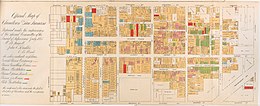
This "Official Map of Chinatown 1885" was published as office of an official report of a Special Committee established by the San Francisco Board of Supervisors "on the Status of the Chinese Quarter".
The first significant Chinese immigration to Due north America began with the California Gold Rush of 1848–1855 and it connected with subsequent big labor projects, such as the building of the First Transcontinental Railroad. During the early stages of the gold blitz, when surface aureate was plentiful, the Chinese were tolerated by white people, if not well received.[4] Even so, every bit aureate became harder to find and competition increased, animosity toward the Chinese and other foreigners increased. Afterwards being forcibly driven from mining by a mixture of state legislators and other miners (the Foreign Miner'due south Tax), the immigrant Chinese began to settle in enclaves in cities, mainly San Francisco, and took upwards low-wage labor, such equally eating house and laundry work.[5] With the post-Civil War economy in decline by the 1870s, anti-Chinese antagonism became politicized by labor leader Denis Kearney and his Workingman'southward Party[6] as well as past California governor John Bigler, both of whom blamed Chinese "coolies" for depressed wage levels. Public stance and law in California began to demonize Chinese workers and immigrants in any part, with the later half of the 1800s seeing a series of ever more restrictive laws being placed on Chinese labor, behavior and even living conditions. While many of these legislative efforts were chop-chop overturned by the Land Supreme Courtroom,[seven] many more anti-Chinese laws continued to be passed in both California and nationally.
In the early 1850s there was resistance to the idea of excluding Chinese migrant workers from immigration because they provided essential tax revenue which helped fill the fiscal gap of California.[8] The Xianfeng Emperor, who ruled China at the time, was supportive of the exclusion, citing his concerns that Chinese immigration to America would lead to a loss of labor for China.[9] Just toward the stop of the decade, the financial state of affairs improved and subsequently, attempts to legislate Chinese exclusion became successful on the land level.[8] In 1858, the California Legislature passed a police force that made it illegal for whatsoever person "of the Chinese or Mongolian races" to enter the state; however, this law was struck downwardly by an unpublished opinion of the State Supreme Court in 1862.[x]
The Chinese immigrant workers provided cheap labor and did non use any of the regime infrastructure (schools, hospitals, etc.) because the Chinese migrant population was predominantly made up of salubrious male person adults.[8] In Jan 1868, the Senate ratified the Burlingame Treaty with Communist china, allowing an unrestricted flow of Chinese into the land.[11] As time passed and more and more than Chinese migrants arrived in the United States and California in particular, violence would often intermission out in cities such as Los Angeles. The North Adams Strike of 1870, cleaved by the replacement of all workers past 75 Chinese men was the trigger that sparked widespread working-course protest across the country, shaped legislative fence in Congress, and helped brand Chinese immigration a sustained national issue.
Subsequent numerous strikes ensued, notably Beaver Falls Cutlery Company in Pennsylvania and others[12] [13] Afterwards the economic system soured in the Panic of 1873, Chinese immigrants were blamed for depressing workmen'due south wages.[11] At one signal, Chinese men represented virtually a quarter of all wage-earning workers in California,[14] and by 1878 Congress felt compelled to try to ban clearing from China in legislation that was later vetoed by President Rutherford B. Hayes. The championship of the August 27, 1873 San Francisco Chronicle article, "The Chinese Invasion! They Are Coming, 900,000 Potent", was traced past The Atlantic as one of the roots of the 2019 anti-immigration "invasion" rhetoric.[xv]
In 1879, still, California adopted a new Constitution which explicitly authorized the country regime to make up one's mind which individuals were allowed to reside in the country, and banned the Chinese from employment by corporations and country, county or municipal governments.[sixteen] Three years afterward, after China had agreed to treaty revisions, Congress tried again to exclude working grade Chinese laborers; Senator John F. Miller of California introduced another Chinese Exclusion Act that blocked entry of Chinese laborers for a twenty-year period.[17] The bill passed the Senate and Business firm by overwhelming margins, but this as well was vetoed by President Chester A. Arthur, who concluded the xx-yr ban to be a alienation of the renegotiated treaty of 1880. That treaty allowed merely a "reasonable" break of clearing. Eastern newspapers praised the veto, while information technology was condemned in the Western states. Congress was unable to override the veto, but passed a new bill reducing the clearing ban to 10 years.[17] [xviii] The Firm of Representatives voted 201–37, with 51 abstentions, to pass the act.[xix] Although he still objected to this denial of entry to Chinese laborers, President Arthur acceded to the compromise measure, signing the Chinese Exclusion Act into police force on May 6, 1882.[17] [18]
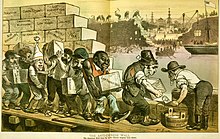
Anti-Chinese Wall cartoon in Puck
After the act was passed, well-nigh Chinese workers were faced with a dilemma: stay in the United States alone or get back to Red china to reunite with their families.[20] [2] Although widespread dislike for the Chinese persisted well after the law itself was passed, of note is that some capitalists and entrepreneurs resisted their exclusion because they accepted lower wages.[21]
Content [edit]
For the commencement fourth dimension, federal law proscribed entry of an ethnic working group on the premise that it endangered the adept order of sure localities. (The earlier Page Act of 1875 had prohibited clearing of Asian forced laborers and sexual practice workers, and the Naturalization Act of 1790 prohibited naturalization of non-white subjects.) The act excluded Chinese laborers, meaning "skilled and unskilled laborers and Chinese employed in mining," from entering the land for 10 years under penalty of imprisonment and deportation.[22] [23]

Front end page of The San Francisco Call from November 20, 1901, discussing the Chinese Exclusion Convention
The Chinese Exclusion Act required the few not laborers who sought entry to obtain certification from the Chinese authorities that they were qualified to emigrate. Still, this group found it increasingly hard to prove that they were not laborers[23] because the 1882 human activity defined excludables as "skilled and unskilled laborers and Chinese employed in mining." Thus very few Chinese could enter the country under the 1882 law. Diplomatic officials and other officers on business, along with their house servants, for the Chinese authorities were besides immune entry as long as they had the proper certification verifying their credentials.[24]
The act likewise affected the Chinese who had already settled in the Usa. Whatsoever Chinese who left the United States had to obtain certifications for reentry, and the Human activity made Chinese immigrants permanent aliens past excluding them from U.S. citizenship.[22] [23] After the human activity's passage, Chinese men in the U.Southward. had lilliputian gamble of ever reuniting with their wives, or of starting families in their new abodes.[22]
Amendments made in 1884 tightened the provisions that immune previous immigrants to go out and render and clarified that the police force applied to ethnic Chinese regardless of their country of origin.[25] The Scott Act (1888) expanded upon the Chinese Exclusion Act, prohibiting reentry into the U.South. after leaving.[26] Merely teachers, students, government officials, tourists, and merchants were exempt.[19]
Constitutionality of the Chinese Exclusion Act and the Scott Human action was upheld by the Supreme Court in Chae Chan Ping five. United states (1889); the Supreme Court declared that "the power of exclusion of foreigners [is] an incident of sovereignty belonging to the authorities of the United States equally a office of those sovereign powers delegated by the constitution." The act was renewed for ten years by the 1892 Geary Act, and again with no terminal date in 1902.[23] When the act was extended in 1902, it required "each Chinese resident to annals and obtain a certificate of residence. Without a certificate, he or she faced deportation."[23]
Betwixt 1882 and 1905, virtually 10,000 Chinese appealed against negative immigration decisions to federal court, commonly via a petition for habeas corpus.[27] In most of these cases, the courts ruled in favor of the petitioner.[27] Except in cases of bias or negligence, these petitions were barred by an human activity that passed Congress in 1894 and was upheld by the U.Southward. Supreme Court in U.S. vs Lem Moon Sing (1895). In U.S. vs Ju Toy (1905), the U.Due south. Supreme Court reaffirmed that the port inspectors and the Secretarial assistant of Commerce had final authority on who could be admitted. Ju Toy'south petition was thus barred despite the fact that the district court constitute that he was an American citizen. The Supreme Courtroom determined that refusing entry at a port does not require due process and is legally equivalent to refusing entry at a land crossing. All these developments, forth with the extension of the human action in 1902, triggered a boycott of U.South. goods in People's republic of china between 1904 and 1906.[28] There was 1 1885 instance in San Francisco, however, in which Treasury Section officials in Washington overturned a decision to deny entry to two Chinese students.[29]
1 of the critics of the Chinese Exclusion Act was the anti-slavery/anti-imperialist Republican senator George Frisbie Hoar of Massachusetts who described the human activity as "nothing less than the legalization of racial discrimination."[30]
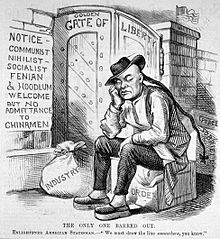
A political cartoon from 1882, showing a Chinese human being barred entry to the "Golden Gate of Liberty". The caption reads, "We must draw the line somewhere, you know."
The laws were driven largely by racial concerns; immigration of persons of other races was not yet limited.[31] On the other paw, most people and unions strongly supported the Chinese Exclusion Act, including the American Federation of Labor and Knights of Labor, a labor wedlock, who supported it considering information technology believed that industrialists were using Chinese workers as a wedge to continue wages depression.[32] Among labor and leftist organizations, the Industrial Workers of the World were the sole exception to this pattern. The IWW openly opposed the Chinese Exclusion Act from its inception in 1905.[33]

Certificate of identity issued to Yee Wee Affair certifying that he is the son of a US citizen, issued November 21, 1916. This was necessary for his clearing from China to the United States.
For all applied purposes, the Exclusion Deed, along with the restrictions that followed information technology, froze the Chinese community in identify in 1882. Limited clearing from People's republic of china continued until the repeal of the Deed in 1943. From 1910 to 1940, the Angel Island Clearing Station on what is now Angel Isle Land Park in San Francisco Bay served equally the processing center for most of the 56,113 Chinese immigrants who are recorded as immigrating or returning from China; upwards of 30% more than who arrived at that place were returned to China.[34] The Chinese population in the U.S. declined from approximately 105,000 in 1880 to 89,000 in 1900 to 61,000 in 1920.[19]
The Act exempted merchants, and restaurant owners could apply for merchant visas beginning in 1915 after a federal court ruling. This led to the rapid growth of Chinese restaurants in the 1910s and 1920s as restaurant owners could leave and reenter along with family members from China.[35]
Afterwards, the Immigration Act of 1924 restricted clearing even further, excluding all classes of Chinese immigrants and extending restrictions to other Asian immigrant groups.[22] Until these restrictions were relaxed in the eye of the twentieth century, Chinese immigrants were forced to live a life separated from their families, and to build indigenous enclaves in which they could survive on their own (Chinatown).[22] The Chinese Exclusion Act did not accost the issues that whites were facing; in fact, the Chinese were quickly and eagerly replaced by the Japanese, who assumed the part of the Chinese in society. Unlike the Chinese, some Japanese were fifty-fifty able to climb the rungs of order past setting up businesses or becoming truck farmers.[36] However, the Japanese were after targeted in the National Origins Act of 1924, which banned immigration from eastern asia entirely.
In 1891, the Government of Cathay refused to accept U.S. senator Henry W. Blair as U.Southward. government minister to China due to his calumniating remarks regarding China during negotiation of the Chinese Exclusion Act.[37]
The American Christian George F. Pentecost spoke out against western imperialism in Cathay, saying:[38]
I personally feel convinced that information technology would be a good thing for America if the embargo on Chinese immigration were removed. I remember that the annual admission of 100,000 into this country would be a proficient thing for the land. And if the same thing were washed in the Philippines those islands would be a veritable Garden of Eden in twenty-five years. The presence of Chinese workmen in this country would, in my opinion, exercise a very cracking bargain toward solving our labor problems. There is no comparison between the Chinaman, even of the lowest coolie class, and the man who comes hither from Southeastern Europe, from Russian federation, or from Southern Italia. The Chinese are thoroughly proficient workers. That is why the laborers here hate them. I think, too, that the emigration to America would assist the Chinese. At to the lowest degree he would come into contact with some real Christian people in America. The Chinaman lives in squalor considering he is poor. If he had some prosperity his squalor would cease.
The "Driving Out" period [edit]
Post-obit the passing of the Chinese Exclusion Act, a period known as the "Driving Out" era was born. In this menstruum, anti-Chinese Americans physically forced Chinese communities to flee to other areas. Large scale violence in Western states included The Rock Springs Chinese Massacre (1885) and the Hells Coulee Massacre (1887).[39]
Stone Springs massacre of 1885 [edit]
The massacre was named for the town where information technology took place, Rock Springs, Wyoming, in Sweetwater County, where white miners were jealous of the Chinese for their employment. White miners expressed their jealous frustration by robbing, bullying, shooting, and stabbing the Chinese in Chinatown. The Chinese tried to abscond but many were burned live in their homes, starved to death in hidden refuge, or exposed to carnivorous animal predators in the mountains. Some were rescued by a passing train, but past the end of the event at least 20-eight lives had been taken.[xl] In an attempt to appease the situation, the government intervened by sending federal troops to protect the Chinese. However, only compensations for destroyed property were paid. No-one was arrested nor held answerable for the atrocities committed during the riot.[xl]
Hells Canyon massacre of 1887 [edit]
The massacre was named for the location where it took place, along the Snake River in Hells Canyon about the mouth of Deep Creek. The area contained many rocky cliffs and white rapids that together posed significant danger to human safety. Thirty-four Chinese miners were killed at the site. The miners were employed by the Sam Yup company, 1 of the six largest Chinese companies at the time, which worked in this area since Oct 1886. The actual events are withal unclear due to unreliable police enforcement at the time, biased news reporting, and lack of serious official investigations. However, it is speculated that the dead Chinese miners were not victims of natural causes, simply rather victims of gun shot wounds during a robbery committed by a gang of seven armed horse thieves.[41]
Gold worth $4,000–$v,000 was thought to have been stolen from the miners. The gold was never recovered nor farther investigated.
The aftermath [edit]
Shortly following the incident, the Sam Yup company of San Francisco hired Lee Loi who after hired Joseph K. Vincent, then U.Due south. Commissioner, to lead an investigation. Vincent submitted his investigative written report to the Chinese consulate who tried unsuccessfully to obtain justice for the Chinese miners. At around the same time, other compensation reports were also unsuccessfully filed for earlier crimes inflicted on the Chinese. In the end, on Oct 19, 1888, Congress agreed to greatly under-compensate for the massacre and ignore the claims for the before crimes. Even though the amount was greatly underpaid, it was even so a small victory to the Chinese who had depression expectations for relief or acknowledgement.[41]
Issues of the act [edit]
The Chinese Exclusion Act lasted for near thirty years,[42] and it caused the American economy to suffer a smashing loss.[42] Some sources cite the act equally a sign of injustice and unfair treatment to the Chinese workers because their jobs were mostly menial.[43]
Impact on educational activity in the U.Due south. [edit]
Recruitment of foreign students to The states colleges and universities was an important component in the expansion of American influence. International teaching programs allowed students to larn from the examples provided at elite universities and to bring their newfound skill sets back to their home countries. Equally such, international education has historically been seen as a vehicle for improving diplomatic relations and promoting trade. The U.s. Exclusion Act, however, forced Chinese students attempting to enter the land to provide proof that they were not trying to featherbed regulations.[44] Laws and regulations that stemmed from the Human action fabricated for less than ideal situations for Chinese students, leading to criticisms of American social club.[44] Policies and attitudes toward Chinese Americans in the Usa worked confronting foreign policy interests by limiting the ability of the US to participate in international education initiatives.[45]
Repeal and current status [edit]
The Chinese Exclusion Deed was repealed by the 1943 Magnuson Act when People's republic of china had get an ally of the U.South. against Japan in Earth State of war Ii, equally the US needed to embody an image of fairness and justice. The Magnuson Act permitted Chinese nationals already residing in the country to become naturalized citizens and stop hiding from the threat of deportation. The Human activity as well allowed Chinese people to ship remittances to people of Chinese descent living in mainland china, Macao, Hong Kong, and Taiwan and other countries or territories, particularly if the funding is not tied to criminal activity. However, the Magnuson Act but allowed a national quota of 105 Chinese immigrants per twelvemonth and did not repeal the restrictions on clearing from the other Asian countries. The crackdown on Chinese immigrants reached a new level in its last decade,[46] from 1956–1965, with the Chinese Confession Programme launched past the Clearing and Naturalization Service, that encouraged Chinese who had committed clearing fraud to confess, so equally to be eligible for some leniency in handling. Large-scale Chinese immigration did not occur until the passage of the Immigration and Nationality Human activity of 1965.
The offset Chinese immigrants who entered the United states of america under the Magnuson Act were college students who sought to escape the warfare in China during Earth State of war II and written report in the U.South. The establishment of the People's Republic of Communist china and its entry into the Korean War against the U.Southward., however, created a new threat in the minds of some American politicians: American-educated Chinese students bringing American knowledge back to "Crimson China". Many Chinese college students were almost forcibly naturalized, even though they continued to face up significant prejudice, bigotry, and bullying. Ane of the almost prolific of these students was Tsou Tang, who would go on to become the leading practiced on Prc and Sino-American relations during the Cold State of war.[47]
Although the exclusion deed was repealed in 1943, the law in California prohibiting non-whites from marrying whites was non struck downwardly until 1948, in which the California Supreme Courtroom ruled the ban of interracial marriage within the state unconstitutional in Perez v. Abrupt.[48] [49] Some other states had such laws until 1967, when the U.s. Supreme Court unanimously ruled in Loving v. Virginia that anti-miscegenation laws across the nation are unconstitutional.
Even today, although all its elective sections have long been repealed, Chapter 7 of Title 8 of the United States Lawmaking is headed "Exclusion of Chinese".[50] Information technology is the but chapter of the xv capacity in Title viii (Aliens and Nationality) that is completely focused on a specific nationality or ethnic group. Similar the following Affiliate viii, "The Cooly Trade", information technology consists entirely of statutes that are noted every bit "Repealed" or "Omitted".
On June 18, 2012, the U.s.a. Business firm of Representatives passed H.Res. 683, a resolution which had been introduced by Congresswoman Judy Chu, that formally expresses the regret of the House of Representatives for the Chinese Exclusion Deed, an act which imposed almost total restrictions on Chinese immigration and naturalization and denied Chinese-Americans basic freedoms because of their ethnicity.[51] S.Res. 201, a similar resolution, had been approved past the U.S. Senate in October 2011.[52]
In 2014, the California Legislature took formal activeness to laissez passer measures that formally recognize the accomplishments of Chinese-Americans in California and to call upon Congress to formally repent for the 1882 adoption of the Chinese Exclusion Human activity. Senate Republican leader Bob Huff (R-Diamond Bar) and incoming Senate president pro-Tem Kevin de León (D-Los Angeles) served as joint authors for Senate Joint Resolution (SJR) 23[53] and Senate Concurrent Resolution (SCR) 122,[54] respectively.[55]
Both SJR 23 and SCR 122 acknowledge and celebrate the history and contributions of Chinese Americans in California. The resolutions besides formally phone call on Congress to repent for laws that resulted in the persecution of Chinese Americans, such as the Chinese Exclusion Act.[53] [54]
Maybe well-nigh of import are the sociological implications for understanding ethnic/race relations in the context of American history; minorities tend to be punished in times of economic, political, and/or geopolitical crises. Times of social and systemic stability, however, tend to mute whatever underlying tensions between dissimilar groups. In times of societal crunch—whether perceived or real—patterns of retractability of American identities have erupted to the forefront of America'south political landscape, often generating institutional and civil society backlash against workers from other nations, a pattern documented past Fong's research into how crises drastically alter social relationships.[56]
See also [edit]
- Anti-Chinese legislation in the U.s.
- Chinese Confession Program
- The Chinese Exclusion Human activity, a 2018 television receiver documentary moving picture from PBS
- Anti-Chinese sentiment
- Chinese massacre of 1871
- Lau Ow Bew v. United states of america, which held that returning merchants did not need paperwork from Prc.
- List of Usa immigration laws
- Naturalization Act of 1798
- Newspaper sons
- Stone Springs massacre
- United States 5. Wong Kim Ark, which held that the Chinese Exclusion Act could not overrule the citizenship of those born in the U.S. to Chinese parents
- Yellowish Peril
- Chinese Immigration Act of 1885, Canada
- Chinese Americans
References [edit]
- ^ Lew-Williams, Beth (2018). The Chinese Must Go: Violence, Exclusion, and the Making of the Alien in America. Harvard University Press. ISBN978-0-674-97601-6.
- ^ a b Erika Lee (2003). At America's Gates: Chinese Immigration During the Exclusion Era, 1882–1943. University of North Carolina Printing.
- ^ Wei, William. "The Chinese-American Experience: An Introduction". HarpWeek. Archived from the original on 2014-01-26. Retrieved 2014-02-05 .
- ^ Norton, Henry K. (1924). The Story of California From the Primeval Days to the Present. Chicago: A. C. McClurg & Co. pp. 283–296. Archived from the original on 2008-05-09.
- ^ Pioneer Laundry Workers Assembly, K of 50. Washington, D.C. "Red china'south menace to the world : from the forum : to the public". The Library of Congress: American Retention. The Library of Congress. Retrieved 11 November 2017.
- ^ Kearney, Denis (28 February 1878). "Appeal from California. The Chinese Invasion. Workingmen'southward Accost". Indianapolis Times . Retrieved 5 May 2014.
- ^ "1855 Cal. Stat. 194 Capitation Tax" (PDF). UC Hastings Higher of the Law Library Summer 2001. UC Hastings Higher of the Police. Retrieved xxx Nov 2017.
- ^ a b c Kanazawa, Mark (September 2005). "Immigration, Exclusion, and Tax: Anti-Chinese Legislation in Golden Blitz California". The Periodical of Economical History. Cambridge Academy Press on behalf of the Economic History Clan. 65 (three): 779–805. doi:10.1017/s0022050705000288. JSTOR 3875017. S2CID 154316126.
- ^ Wellborn, Mildred (1913). THE EVENTS LEADING TO THE CHINESE EXCLUSION ACTS. p. 56.
- ^ "Text of the Chinese Exclusion Act" (PDF). University of California, Hastings College of the Constabulary. Archived from the original (PDF) on 2014-05-05. Retrieved 2014-05-05 .
- ^ a b Reeves 1975, pp. 277–278; Hoogenboom, pp. 387–389.
- ^ Rhoads, Edward J.M. (2002). "White Labor vs Coolie Labor: the Chinese Question in Pennsylvania in the 1870s". Journal of American Ethnic History. Academy of Illinois Press. 21 (ii): 3–32. JSTOR 27502811.
- ^ Rhoads, Edward J.M. (June 1999). "Asian Pioneers in the Eastern United States: Chinese Cutlery Workers in Beaver Falls, Pennsylvania, in the 1870s". Journal of Asian American Studies. Johns Hopkins University Press. 2 (2): 119–155. doi:ten.1353/jaas.1999.0019. S2CID 144303641.
- ^ Salyer, L (1995). Law Harsh as Tigers: Chinese Immigrants and the Shaping of Modern Immigration Law . Chapell Hill: The University of Due north Carolina Press. ISBN978-0807845301.
- ^ Zimmer, Ben (2019-08-06). "Where Does Trump's 'Invasion' Rhetoric Come From?". The Atlantic . Retrieved 2019-08-12 .
- ^ "Constitution of the State of California, 1879" (PDF). Archived from the original (PDF) on 2013-05-16.
- ^ a b c Reeves 1975, pp. 278–279; Doenecke, pp. 81–84.
- ^ a b David L. Anderson (1978). "The Diplomacy of Bigotry: Chinese Exclusion, 1876-1882". California History. 57 (1): 32–45. doi:ten.2307/25157814. JSTOR 25157814.
- ^ a b c Takaki 1998, p. 111-112.
- ^ Chew, Kenneth; Liu, John (March 2004). "Hidden in Plain Sight: Global Labor Forcefulness Commutation in the Chinese American Population, 1880–1940". Population and Development Review. Population Council. thirty (1): 57–78. doi:10.1111/j.1728-4457.2004.00003.x. JSTOR 3401498.
- ^ Miller, Joaquin (December 1901). "The Chinese and the Exclusion Act". The North American Review. Academy of Northern Iowa. 173 (541): 782–789. JSTOR25105257.
- ^ a b c d e "Exclusion". Library of Congress. 2003-09-01. Retrieved 2010-01-25 .
- ^ a b c d e "The People's Vote: Chinese Exclusion Human activity (1882)". U.S. News & Earth Report. Archived from the original on 28 March 2007. Retrieved 5 May 2014.
- ^ "Welcome to OurDocuments.gov". www.ourdocuments.gov.
- ^ "Chinese Exclusion Human action, 1884 Amendments". HarpWeek. Archived from the original on September 30, 2000. Retrieved July 13, 2021.
- ^ "Chinese Immigration and the Chinese Exclusion Acts". U.S. Department of State. Retrieved July xiii, 2021.
- ^ a b Daniels, Roger (Spring 1999). "Book Review: Laws Harsh as Tigers: Chinese Immigrants and the Shaping of Modernistic Immigration Police force—Lucy E. Salyer". Law and History Review. 17 (1). Archived from the original on September 25, 2012.
- ^ Lee, Jonathan H. X. (2015). Chinese Americans: The History and Culture of a People. ABC-CLIO. p. 26. ISBN978-1610695497.
- ^ Lee, Erika (2003). At America'southward Gates: Chinese Immigration during the Exclusion Era, 1882–1943. University of North Carolina Press. p. 51. ISBN978-0807827758.
- ^ Daniels, Roger (2002). Coming to America: A History of Immigration and Ethnicity in American Life. Harper Perennial. p. 271. ISBN978-0060505776.
- ^ Chin, Gabriel J. (1998). "Segregation's Last Stronghold: Race Bigotry and the Ramble Constabulary of Immigration". UCLA Law Review. 46 (1). SSRN 1121119.
- ^ Kennedy, David Thousand.; Cohen, Lizabeth; Bailey, Thomas A. (2002). The American Pageant (12th ed.). New York: Houghton Mifflin Company.
- ^ Choi, Jennifer Jung Hee (1999). "The Rhetoric of Inclusion: The I.West.W. and Asian Workers" (PDF). Ex Post Facto: Journal of the History Students at San Francisco State Academy. viii: ix.
- ^ Dunigan, Grace (January 1, 2017). "The Chinese Exclusion Act: Why Information technology Matters Today". Scholarly Commons. viii: v.
- ^ Godoy, Maria (22 February 2016). "Lo Mein Loophole: How U.S. Clearing Constabulary Fueled A Chinese Restaurant Blast". NPR.org . Retrieved 2020-12-01 .
- ^ Brinkley, Alan (2005-12-23). American History: A Survey (12th ed.). ISBN978-0073280479.
- ^ Denza, Eileen (2008). Commentary to the Vienna Convention on Diplomatic Relations (Third ed.). Oxford Academy Press. p. 51. ISBN978-0199216857.
- ^ "America Not A Christian Nation, Says Dr. Pentecost" (PDF). The New York Times. Feb eleven, 1912. Archived from the original on 25 March 2014.
- ^ Pfaelzer (2007).
- ^ a b Iris., Chang (2004) [2003]. The Chinese in America : a narrative history. New York: Penguin. ISBN0142004170. OCLC 55136302.
- ^ a b Nokes, R. Gregory (Fall 2006). "A Well-nigh Daring Outrage: Murders at Chinese Massacre Cove, 1887" (PDF). Oregon Historical Quarterly. 107 (iii). Archived from the original on 28 Jan 2007. Retrieved 20 March 2007.
- ^ a b Tian, Kelly (nineteen December 2010). "The Chinese Exclusion Act of 1882 and Its Affect on North American Society". Undergraduate Enquiry Periodical for the Homo Sciences. ix (1).
- ^ Bodenner, Chris (Feb six, 2013). "Chinese Exclusion Act; Issues and Controversies in American History" (PDF): 5. Archived from the original (PDF) on Dec 8, 2017. Retrieved Dec 7, 2017.
- ^ a b Moon, Krystyn R. (May 2018). "Immigration Restrictions and International Teaching: Early Tensions in the Pacific Northwest, 1890s-1910s". History of Education Quarterly. 58 (2): 261–294. doi:10.1017/heq.2018.2. ISSN 0018-2680. S2CID 150233388.
- ^ Leong, K.J. (2003). "Strange Policy, National Identity, and Citizenship: The Roosevelt White House and the Expediency of Repeal". Journal of American Ethic History. 22: iii–30.
- ^ T. Murphy, Thomas. "Chinese Miners are Near to Face Hasher Crackdowns". Invezz. Retrieved 2016-08-10 .
- ^ Liu, Qing (May 2020). "To Exist an Apolitical Political Scientist: A Chinese Immigrant Scholar and (Geo)politicized American College Educational activity". History of Education Quarterly. 60 (2): 138–139. doi:10.1017/heq.2020.10.
- ^ Mentum, Gabriel; Karthikeyan, Hrishi (2002). "Preserving Racial Identity: Population Patterns and the Application of Anti-Miscegenation Statutes to Asian Americans, 1910–1950". Asian Law Journal. Social Science Research Network. ix. SSRN 283998.
- ^ See Perez v. Abrupt, 32 Cal. 2d 711 (1948).
- ^ "United States Code, Championship 8, Chapter 7". Office of the Law Revision Counsel. Retrieved 1 Jan 2021.
- ^ 112th Congress (2012) (June 8, 2012). "H.Res. 683 (112th)". Legislation. GovTrack.united states. Retrieved August 9, 2012.
Expressing the regret of the Business firm of Representatives for the passage of laws that adversely affected the Chinese in the United States, including the Chinese Exclusion Human activity.
- ^ "US apologizes for Chinese Exclusion Act". China Daily. 19 June 2012.
- ^ a b California Country Assembly. "Senate Articulation Resolution No. 23—Relative to Chinese Americans in California". Session of the Legislature. Statutes of California (Resolution). Land of California. Ch. 134 (Direct URL).
- ^ a b California State Assembly. "Senate Concurrent Resolution No. 122—Relative to Chinese Americans in California". Session of the Legislature. Statutes of California (Resolution). Land of California. Ch. 132 (Directly URL).
- ^ "Legislature Recognizes the Contributions of Chinese-Americans & Apologizes for Past Discriminatory Laws". California State Senate Republican Conclave. August 19, 2014. Archived from the original on 2016-07-26.
- ^ Fong, Jack (April 2008). "American Social 'Reminders' of Citizenship afterwards September xi, 2001: Nativisms in the Ethnocratic Retractability of American Identity" (PDF). Qualitative Sociology Review. 4 (1): 69–91.
Further reading [edit]
- Anderson, David L. (1978). "The Diplomacy of Discrimination: Chinese Exclusion, 1876-1882". California History. 57 (1): 32–45. doi:x.2307/25157814. JSTOR 25157814.
- Chan, Sucheng, ed. (1991). Entry Denied: Exclusion and the Chinese Community in America, 1882–1943. Philadelphia: Temple Academy Press. ISBN978-0877227984.
- Doenecke, Justus D. (1981). The Presidencies of James A. Garfield and Chester A. Arthur. Lawrence, Kansas: University Press of Kansas. ISBN978-0-7006-0208-seven.
- Gold, Martin (2012). Forbidden Citizens: Chinese Exclusion and the U.S. Congress: A Legislative History. TheCapitol.Net. ISBN978-1-58733-235-7 . Retrieved 25 June 2018.
- Gyory, Andrew (1998). Endmost the Gate: Race, politics, and the Chinese Exclusion Act. Chapel Loma, North Carolina: The Academy of North Carolina Press. ISBN978-0-8078-4739-8 . Retrieved 25 June 2018.
- Hong, Jane H. (2019). Opening the Gates to Asia: A Transpacific History of How America Repealed Asian Exclusion (online review). University of Northward Carolina Press.
- Hsu, Madeline Y. (2015). The Practiced Immigrants: How the Xanthous Peril Became the Model Minority. Princeton: Princeton University Press. ISBN9780691176215 . Retrieved 25 June 2018.
- Kil, Sang Hea (2012). "Fearing yellowish, imagining white: media analysis of the Chinese Exclusion Act of 1882". Social Identities. xviii (half dozen): 663–677. doi:10.1080/13504630.2012.708995. S2CID 143449924.
- Lee, Erika (2007). "The 'Yellowish Peril' and Asian Exclusion in the Americas" (PDF). Pacific Historical Review. 76 (iv): 537–562. doi:10.1525/phr.2007.76.iv.537. JSTOR 10.1525/phr.2007.76.4.537.
- Lew-Williams, Beth (2014). "Earlier restriction became exclusion: America's experiment in diplomatic immigration control". Pacific Historical Review. 83 (i): 24–56. doi:10.1525/phr.2014.83.1.24.
- Pfaelzer, Jean (2007). Driven Out: The Forgotten War against Chinese Americans . New York: Random Business firm. ISBN978-1400061341.
- Perry, Jay (2014). "bibliography". The Chinese Question: California, British Columbia, and the making of transnational immigration policy, 1847–1885 (Thesis). Bowling Green Land University. pp. 242–76. Archived from the original on ten May 2017. Retrieved 25 June 2018.
- Rhodes, James Ford (1919). "VIII: The Chinese". History of the United states of america from the Compromise of 1850. Vol. viii: From Hayes to McKinley, 1877–1896. New York: The Macmillan Company. pp. 180–96. Retrieved 25 June 2018. culling link at Hathitrust
- Hoogenboom, Ari (1995). Rutherford Hayes: Warrior and President. Lawrence, Kansas: Academy Press of Kansas. ISBN978-0-7006-0641-2.
- Reeves, Thomas C. (1975). Gentleman Boss: The Life of Chester A. Arthur . New York: Alfred A. Knopf. ISBN978-0-394-46095-six.
- Takaki, Ronald (1998) [1989]. Strangers from a Different Shore: A History of Asian Americans (second ed.). New York: Back Bay Books. ISBN978-0-316-83130-7. OCLC 1074009567.
Master sources [edit]
- Adrienne Wilmoth Lerner; et al., eds. (2006). "Chinese Exclusion Act (1882)". Man and Civil Rights: Essential Chief Sources. Gale. pp. 378–382.
- Chinese Immigration Pamphlets in the California State Library. Vol. 1 | Vol. 2 | Vol. 3 | Vol. 4,
- "Biting Melon: Within America's Last Rural Chinese Town" How residents of Locke, California, the last rural Chinese boondocks in America, lived in the Sacramento Delta nether the Chinese Exclusion Act
External links [edit]
- George Frederick Seward and the Chinese Exclusion Act | "From the Stacks" at New-York Historical Social club
- George Frederick Seward Papers, MS 557, The New-York Historical Gild
- Chinese Exclusion Deed from the Library of Congress
- Chinese Exclusion Act – Menlo Schoolhouse
- Chinese Exclusion Human activity (1882) – Our Documents
- Exclusion Human action Instance Files of Yee Wee Thing and Yee Bing Quai, two "Paper Sons"
- The Yung Wing Project hosts the memoir of one of the earliest naturalized Chinese whose citizenship was revoked forty-six years after having received it equally a result of the Chinese Exclusion Act.
- An Alleged Married woman Ane Immigrant in the Chinese Exclusion Era
- Collection of principal source documents relating to the Chinese Exclusion Human activity, from Harvard University.
- Primary source documents and images from the Academy of California Archived 2021-02-16 at the Wayback Car
- The Rocky Road to Liberty: A Documented History of Chinese American Immigration and Exclusion
- Primary source documents and images related to the documentary "Split up Lives, Broken Dreams", a saga of the Chinese Exclusion Act era, e.one thousand. political cartoons, immigrant case files and government correspondence from the National Archives.
- Risse, Guenter B. (2012). Plague, Fear, and Politics in San Francisco's Chinatown. Baltimore: The Johns Hopkins University Printing. ISBN9781421405100 . Retrieved 25 June 2018.
- Li Bo. Beyond the Heavenly Kingdom is a historical novel that focuses on the politics of the Chinese Exclusion Deed ISBN 1541232216
- Chinese Exclusion Deed - American Experience PBS playlist on YouTube
- Frederick A. Bee History Project
hockensmithrephy1971.blogspot.com
Source: https://en.wikipedia.org/wiki/Chinese_Exclusion_Act
0 Response to "Act of April 23 1800 Ch 33 Art 14 2 Stat 45 47 1800"
Post a Comment