Moments in Love Art of Noise Free Mp3 Download
| Art of Noise | |
|---|---|
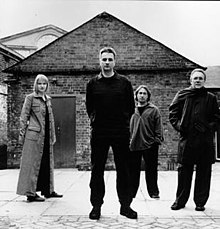 Dudley, Morley, Creme and Horn (from the fourth and final Art of Dissonance line-upwardly in 1998–2000) | |
| Background data | |
| Also known as | The Epitome of a Group, Vision |
| Origin | London, England |
| Genres | Synth-popular, electronic, avant-garde, new wave, sampledelia |
| Years active | 1983–1990[1] [2] [three] 1998–2000 2017 |
| Labels | ZTT, Island, Mainland china, Chrysalis, Polydor, Universal |
| Associated acts | Aye, The Buggles, The Trevor Horn Ring, The World's Famous Supreme Team, Malcolm McLaren |
| Website | theartofnoiseonline |
| By members | Anne Dudley J. J. Jeczalik Gary Langan Trevor Horn Paul Morley Lol Creme |
Art of Dissonance (too The Fine art of Dissonance) were an English language avant-garde synth-pop group formed in early 1983[two] [3] [4] by engineer/producer Gary Langan and programmer J. J. Jeczalik, along with keyboardist/arranger Anne Dudley, producer Trevor Horn, and music journalist Paul Morley.[5] The group had international Top xx hits with its interpretations of "Kiss", featuring Tom Jones, and the instrumental "Peter Gunn", which won a 1986 Grammy Award.
The group'southward mostly instrumental compositions were novel melodic sound collages based on digital sampler engineering, which was new at the time. Inspired past turn-of-the-20th-century revolutions in music, the Art of Dissonance were initially packaged as a faceless anti- or not-group, blurring the distinction between the art and its creators. The band is noted for innovative apply of electronics and computers in pop music and particularly for innovative utilize of sampling.
From the earliest releases on ZTT, the band referred to itself as both Art of Noise and The Art of Noise. Official and unofficial releases and printing material employ both versions.
History [edit]
Beginnings [edit]
The technological impetus for the Art of Noise was the advent of the Fairlight CMI sampler, an electronic musical instrument invented in Australia. With the Fairlight, short digital sound recordings chosen samples could be "played" through a pianoforte-like keyboard, while a reckoner processor altered such characteristics as pitch and timbre. Music producer Trevor Horn was amidst the first people to purchase a Fairlight. While some musicians were using samples as adornment in their works, Horn and his colleagues saw the potential to craft unabridged compositions with the sampler, disrupting the traditional stone aesthetic. (Others were also working contemporaneously toward this goal, such as Jean-Michel Jarre, Yello, and Tony Mansfield, who had made extensive use of the Fairlight for the eponymous debut album by Naked Optics, while Yellow Magic Orchestra had extensively used sampling on their 1981 album Technodelic).
In 1981, Horn's production team included programmer J. J. Jeczalik, engineer Gary Langan and keyboard player/string arranger Anne Dudley.[half-dozen] The team produced ABC'southward 1982 debut anthology The Lexicon of Love, increasingly using the Fairlight to tweak live-based elements of operation but also to embellish the compositions with sound furnishings such as a cash register's bong on "Date Stamp" (Dudley too co-wrote a track on the album, which launched her scoring career). The team too worked on Malcolm McLaren'south 1982 album Duck Stone and would proceed to work with Frankie Goes to Hollywood on what would become the album Welcome to the Pleasuredome (realised predominantly on Fairlight).
During January 1983, Horn's team were working on the Yep comeback anthology 90125 – Horn as producer, Langan as engineer, and Dudley and Jeczalik providing arrangements and keyboard programming. During the sessions, Jeczalik and Langan took a scrapped Alan White drum riff and sampled it into the Fairlight using the device's Page R sequencer (the showtime fourth dimension an entire pulsate blueprint had been sampled into the machine). Jeczalik and Langan then added non-musical sounds on meridian of it, earlier playing the rail to Horn. This in plough resulted in the Red & Blue Mix of Yes's "Owner of a Alone Centre" single, which showcased the prototype sound of The Art of Noise.
Seeing farther potential in the idea, Horn teamed Jeczalik and Langan with Dudley in February to develop the project and brought in ane of his business partners, ex-NME journalist Paul Morley, as a provider of concepts, art direction and marketing ideas. Morley came up with the projection proper name (taken from the essay "The Art of Noises" by noted futurist Luigi Russolo, and finalised at Jeczalik's request by dropping the concluding 's'). Much later, in a July 2002 article penned for The Guardian, Morley wrote "I loved the name Art of Noise and then much that I forced my way into the grouping. If over the years people asked me what I did in the grouping, I replied that I named them, and it was such a not bad name, that was plenty to justify my part. I was the Ringo Starr of Fine art of Noise. I fabricated the tea. Oh, and I wrote the lyrics to one of the loveliest pieces of pop music always, Moments in Love."[vii] Horn himself joined the new group as product counselor and provider of further ideas. This was the first time that he had been part of a group since parting company with his The Buggles' partner Geoff Downes (after they had been part of Yep). It would also be the first and final time that he would bask chart success as an artist since the new wave hit in 1979 with "Video Killed the Radio Star".
Who's Afraid of the Art of Noise? (1983–1984) [edit]
The debut Fine art of Noise EP, Into Battle with the Fine art of Noise, appeared in September 1983 on Horn's fledgling ZTT label.[6] Many of the samples originally used on 90125 reappeared on the EP, which immediately scored a striking in the urban and alternative dance charts in the US with the highly percussive, cut-up instrumental track "Beat Box", a favourite amidst trunk-poppers. The track has oft been mistakenly credited by some to be the theme melody for the ITV game show The Krypton Factor. "(Theme From) The Krypton Factor" was actually composed and recorded in 1986 and was reworked equally "Crusoe" on their 1987 album.
The kickoff Art of Noise album, Who's Afraid of the Fine art of Racket? was released in 1984.[6] During this period, the group presented themselves as faceless (using masks, minimal personal appearances, or even absence from promotion to point that the Fine art of Racket was not a standard rock or pop ring which promoted and mythologised its members as individuals).
Anne: When the grouping first started, we idea it would be a good thought to have an epitome that wasn't based effectually a way wait. We thought it would encourage people to look at the music instead of the members of the band. It didn't last for long, though.
Gary: It really doesn't seem a lot different, actually; the responsibility a lot more different; information technology's probably more fun, more risk to it.
Anne: In that location's a very big risk in America because they call up we're blackness; we were voted the 2nd best new blackness act. We are wondering how we tin quite cope with this.
Gary: There was at 1 point at that place came forth an instrument that nobody had really used and nosotros were lucky that we had one nosotros could use. There are certain things you lot can do with it that yous're not able to practice with annihilation else. So it was a question of experimenting with that, and things really took off from there.
Anne: This is the famous Fairlight music computer, which you may have heard of.
Gary: Which plays an of import part. I really think that the music is more important than the personality. The way effectually a personality seems to change a lot quicker than that effectually music.
"Moments in Love", a ten-minute instrumental ode to sensuality that appeared on both Into Boxing and Who'southward Afraid, was remixed and released every bit a single in 1985. The vocal was first released in the United states in 1983, where it was a moderate hit on the United states of america R&B singles chart. It was played at one of Madonna's weddings; sampled past Mýa in her hit unmarried "It's All Nigh Me," which featured Sisqó; used in the soundtrack of the movie Pumping Atomic number 26 2: The Women; featured in the Indian movie Koi...Mil Gaya; name-dropped in the opening pages of Sis Souljah's 2011 novel Midnight and the Meaning of Dear (as "Moments of Beloved"); used in a number of advertisements; and remixed, covered, and sampled by numerous other artists. Information technology has also appeared in numerous chill out compilations and has become a staple of smooth jazz radio station playlists. "Moments in Dear" has been remixed many times, with names such as "Moments in Bed" and "Moments in honey seven" Main Rejected". Almost "Moments in Love" remixes can exist constitute in the box gear up And What Take You Done with My Torso, God?.
An October 1984 characteristic in Smash Hits magazine indicated several of Morley and Horn'due south plans for the group'due south subsequent projects. These included a cover of "Video Killed the Radio Star", originally by The Buggles (Horn and Geoff Downes); Raiding the 20th Century, an album using sounds from throughout the 20th century equally source material; the score for The Living Terminate, a moving picture written by Morley and directed by Godley & Creme; and the soundtrack for a ballet.[8]
"Close (to the Edit)" was issued in Oct that year. The single was Fine art of Noise's outset major UK hit, reaching number 8 in the U.k. Singles Chart in November 1984.[6]
Split of original line-upwards (1985) [edit]
In 1985, Dudley, Jeczalik, and Langan fabricated an begrudging divide from Morley and Horn also as from the ZTT label.[vi]
In a mail service-split interview for Melody Maker in October 1985, Jeczalik indicated that he and Morley did not become along and that he felt Morley'southward writing was pretentious. Jeczalik responded to a question nearly the level of Morley and Horn'south involvement in Who'due south Afraid past saying, "It'southward hard to tell. We say approximately 1.73 percent, merely it could fifty-fifty be every bit high as two percent. You see, all that has happened is that Gary and I started something, it was taken away, and we have taken steps to get it back." In the same interview, Dudley indicated she felt parts of Who's Afraid were of dubious quality.[ix]
Much later, Morley would comment "When Trevor and I left, (Jeczalik, Langan and Dudley) became a novelty group who had hits with Tom Jones." His disdain for the artistic management of The Art of Noise once he was no longer involved with it was even more than evident in other articles he penned, including the liner notes of the 1986 compilation anthology Daft (nether the proper name Otto Flake) and a September 2002 article for The Observer.[7]
In Visible Silence (1986) [edit]
After the split, Dudley, Jeczalik, and Langan moved to the United kingdom-based China Records label, taking the Art of Noise proper noun with them.[vi] Some of the ring's original imagery and ethos was retained for their second album, In Visible Silence. This anthology spawned the Grammy Award-winning cover of the Peter Gunn theme, recorded with Duane Boil, who had a hit with Peter Gunn in 1959.[six] The Art of Racket collaboration reached number two on the Billboard trip the light fantastic toe charts.[10] The Peter Gunn video featured comedian Rik Mayall in a parody of the private eye picture genre. The slice would later exist used equally the theme music for the 2008 BBC TV series Bill Oddie's Wild Side.
From the same album, the "Beat Box"-similar unmarried, "Legs," was a mild surreptitious hit in dance clubs. In 1986, the album track "Paranoimia" achieved some success when a remix of it was released as a unmarried with overdubbed song samples provided by Matt Frewer as the supposedly computer-generated character Max Headroom.[6] Frewer also appeared as Max Headroom in the music video for the rail.
Around 1986, Jeczalik and Dudley started actualization in photographs without masks, alienating some fans that had come up to capeesh Morley's "art for art's sake" aesthetic. The upcoming soundtrack pieces connected The Art of Noise's evolution into a pop ring and away from Morley'southward faceless "non-grouping."
In No Sense? Nonsense!, Below the Waste product, and the divide (1987–1990) [edit]
By 1987, the band's membership was down to merely Jeczalik and Dudley. That twelvemonth saw the release of their album In No Sense? Nonsense! [6] The album featured Jeczalik'south most advanced rhythmic collages to date, plus lush cord arrangements, pieces for boys' choir, and keyboard melodies from Dudley. Information technology did not produce whatever hits, although their record characterization made efforts to push remixes of "Dragnet" into the dance clubs and the single reached No. lx on the UK Singles Chart.
In 1987, The Fine art of Noise provided the score for two movies, Hiding Out and Dragnet, and one particular movement was used in both films. Their contumely-based connecting passage between sections from the original Dragnet goggle box show's theme song was used as incidental music during a dramatic scene—an armed chase through the rafters of a gymnasium—nigh the cease of Hiding Out.
In 1988, a 1-off collaboration with vocalizer Tom Jones (a encompass of Prince'south "Osculation" — a staple in Jones' stage shows) renewed the public'southward interest in the Fine art of Noise and provided the group'due south biggest hit in the mainstream.[vi] The track appeared on several albums by Jones, and Cathay Records included the song on the greatest hits compilation The Best of The Art of Racket, the showtime edition of which also contained tracks licensed from ZTT.
The follow-up album, Below the Waste, failed[ citation needed ] to attain much success upon its release in 1989.[vi] Information technology did spawn the memorable single "Yebo!" (featuring the unique vocals of Zulu performers Mahlathini and the Mahotella Queens). Both cassette and CD versions include ii bonus tracks in the form of "Robinson Crusoe", and the "James Bond Theme".
In 1990, Dudley and Jeczalik alleged that the Art of Racket had officially disbanded.[half-dozen]
Interim (compilations, failed reformations and solo work) [edit]
Although Dudley and Jeczalik had already dissolved the grouping, in 1990 they assisted in the promotion of the lightly remixed compilation The Ambient Collection, which the China characterization released to cash in on the burgeoning ambient house scene. Jeczalik approved the remixes that appeared on The FON Mixes the following year. The rest of the decade saw China Records releasing further Art of Racket compilations: The Pulsate and Bass Collection, Art Works, and reissues of Best of without the ZTT-era tracks. Some of these featured new remixes past other artists.
According to an interview with J.J. Jeczalik reported in the ZTT fanzine Outside World in 1991, Jeczalik, Dudley and Langan were inspired past the commercial success of The FON Mixes and had discussed reuniting the grouping as a trio again. In grooming to record a new album, Jeczalik and Langan travelled to Cuba to get together new source material. All the same, no new recordings were produced with the new line-upward, and the Art of Noise remained defunct.
Dudley became well known for composing numerous film and telly scores during the 1990s. The most famous of these is probably The Full Monty, which won an Academy Award for Original Music Score. She too collaborated with Killing Joke's Jaz Coleman on the 1990 album Songs from the Victorious Urban center [6] (inspired by a trip the two made to Arab republic of egypt) and produced two tracks for the 1993 Deborah Harry album Debravation ("Strike Me Pink", which she as well co-wrote and played keyboards on, and "Mood Ring"). She has scored orchestrations for dozens of pop releases over the years, and both scored and produced the album Vocalism for her neighbor Alison Moyet. Cathy Dennis added lyrics to one of Dudley's compositions and recorded it as "Too Many Walls", which became a US Top 10 hit in 1991.
In 1995–1997, Jeczalik and In No Sense? Nonsense! coengineer Bob Kraushaar produced a number of instrumentals oriented toward dance clubs nether the name Art of Silence, issuing an album titled artofsilence.co.great britain. Jeczalik also embarked on a new career in trading in futures contracts.
The Art of Racket also received a full writing credit for The Prodigy's "Firestarter", which samples the female "hey, hey" voice from "Close to the Edit". The Prodigy too contributed the remix "Instruments of Darkness (All of United states are One People)" to the 1991 compilation The FON Mixes. Likewise, an edited version of "Close to the Edit" is featured on the monthly educational Amiga game, Ready Robot Club. The Art of Dissonance are also credited for the music to the ITV serial The Krypton Factor.
The reunion and The Seduction of Claude Debussy (1998–2000) [edit]
In 1998, Horn, Morley, and Dudley began talking about the original intent of the project, its relevance in 20th-century music, and the impending plough of a new century. The group temporarily reformed, adding guitarist Lol Creme, but without J.J. Jeczalik and Gary Langan. Their engineering, programming and production tasks were carried out by dance deed Manner Out West. An album was recorded – Balance – Music for the Heart – but was never released, although several tracks from this project were included on the 2010 retrospective album Influence.[11] and the whole album was released equally part of At the End of the Century box ready.[12] Instead, a new single called "Dream On" — which featured remixed versions of the forthcoming album track, "Dreaming in Color" — was released to club DJs later in 1998, showcasing mixes by Manner Out Westward.
A second single, "Metaforce", featuring a rap past Rakim, preceded the 1999 release of the concept album The Seduction of Claude Debussy, a cohesive concept album depicting the life and works of Claude Debussy, on the ZTT label.
This album later formed the basis of a 17-infinitesimal soundtrack for London's Millennium fireworks celebrations on the banks of the River Thames. The firework display was synchronised to an edit of "Seduction" which also featured a collage of samples from some of Britain's near famous pop and rock songs, plus classical composers. It was broadcast live on 95.8 Capital FM and BBC London 94.ix. Trevor Horn worked on the projection with Jill Sinclair, Bob Geldof, Capital Radio executive Clive Dickens and producer Ross Ford.[ commendation needed ]
After performing a handful of live shows in the Uk and US, the ring dissolved. A DVD (Into Vision) and CD (Reconstructed) were released in 2002 and 2003 respectively, featuring music recorded and filmed in Chicago, at the Coachella Festival (10 September 1999), at the Shepherd'southward Bush Empire (22 March 2000) and Fountain Studios, Wembley, London (1 June 2000).
Recent work [edit]
A reunion of sorts occurred at a 30 November 2013 alive operation by the BBC Concert Orchestra (with a live BBC radio circulate) including Dudley'south orchestral arrangement of the band'southward EP Into Battle and a new piece entitled "Rhythm of a Decade" by Dudley and narrated by Morley.[13] In their programme notes, they explain "Rhythm of a Decade" was inspired past an unreleased Art of Noise slice: "Of the many Art of Racket albums that did not appear – even if they were recorded – was one that set up out to represent various decades through the rhythms that appeared during that particular decade – charting the development of rhythmical patterns and the concrete changes in pulsate sounds throughout the 1950s, 1960s, 1970s, 1980s and 1990s".[14]

Art of Racket performing live at Liverpool Audio City in May 2017
On 25 May 2017 Art of Noise members Langan, Dudley and Jeczalik reunited as Reboot Art of Noise, performing at Liverpool Sound City as special support for The Human League during the festival'due south Pioneers of British Electronic Music.[xv]
The three appeared once more when they played highlights from their In Visible Silence album plus other career highlights as "Dudley, Jeczalik, Langan" at the British Library in London on 9 March 2018 equally part of the library's "Flavour of Audio" celebrating 140 years of recorded audio. This operation included a recorded video intro and outro from Paul Morley.
Re-releases [edit]
In 2003, a "20th Anniversary Edition" of Into Battle was released the get-go time in CD course in Germany, including bonus tracks and a bonus DVD of their promo videos and a selected discography slideshow of anthology art. The CD substituted the original version of "Beat Box" with the later "Diversion One".
In early 2004, the Karvavena label released an Art of Racket tribute album, The Abduction of The Art of Noise. This album contains covers of various tracks, including a new version of "Beat out Box" performed by J.J. Jeczalik under his Art of Silence moniker. 2004 saw Dudley and Horn perform "Close (To the Edit)" together at a The Prince'south Trust charity result.
In 2006, Lol Creme and Trevor Horn formed Producers, a band fabricated upward of renowned record producers and musicians. Gary Langan is the band'southward audio engineer.
21 August 2006 saw ZTT release a 4-CD Art of Noise box set, titled And What Have You Done with My Trunk, God?, which consisted of tracks exclusively from the 1983–85 ZTT era, from the initial tentative demos created by Gary Langan and J.J. Jeczalik in the wake of the Yep 90125 sessions, to selections from the Ambassadors Theatre performances featuring Horn and Morley, recorded at concerts profiling ZTT acts—prior to which, Langan, Jeczalik, and Dudley had abandoned the label (and, for the time being, the band). The set featured over xl unreleased remixes, demos, and works in progress, as well every bit the complete vinyl version of Into Battle... – sourced from the original masters – for the first time on CD. The projection was conceived, researched and compiled by music journalist (and Fine art of Noise addict) Ian Skin, who also wrote the box prepare's accompanying 36-page book, which featured new interviews with all of the original members.
In April 2011, Pare continued his archiving of classic and vaulted ZTT material, at present named the Element Series, with a Deluxe Edition reissue of Into Battle with the Art of Dissonance. This was intended to be the first of a chronological remastering and repackaging of the Art of Noise'southward output, collating the original album or EP with extended and previously unavailable tracks. Who's Afraid of the Art of Dissonance?, considered the first 'true' AON album, was released every bit a Palatial Edition on xix September 2011.
In May 2017, a ii-disc deluxe edition of In Visible Silence was released. Included is the remastered album, along with several remixes and B-sides, taken from previous 12" singles and available on CD for the start time. Also included are outtakes and unreleased fabric from the grouping'south time with China Records. Shortly thereafter, a like deluxe edition of their next album, In No Sense? Nonsense! was released.
Other piece of work [edit]
The Art of Noise wrote and recorded the theme music to the popular British game show The Krypton Factor which was used from 1986 to 1993; the grouping also composed the short music pieces which introduced each of the 6 rounds. The group also equanimous and performed the opening theme for the third series of the chat show, The Max Headroom Show.
Influence and other compilations [edit]
ZTT Records and Salvo released a new retrospective album titled Influence in July 2010. The album includes the hits, the collaborations, soundtracks and unreleased material spanning both the ZTT & Prc Records periods. 2013 saw the unwelcome release of a European budget price double album "The All-time Of" that was basically "Influence" with all of the Communist china Records material omitted and replaced with various tracks from "Into Boxing", "(Who'south Afraid Of) The Fine art Of Noise!" and "The Seduction Of Claude Debussy". In 2015, ZTT/Salvo issued a two CD and single DVD set called "At The End Of A Century," combining the unreleased "Balance – Music for the Heart" album and a Trevor Horn mix of "The Seduction of Claude Debussy" with its mixes of the unreleased second single "Dreaming In Color."
Discography [edit]
- Who'southward Afraid of the Art of Noise? (1984)
- In Visible Silence (1986)
- In No Sense? Nonsense! (1987)
- Below the Waste (1989)
- The Seduction of Claude Debussy (1999)
DVD and video [edit]
- "The Art of Noise in: Visible Silence" (1986) – a concert filmed in the Hammersmith Odeon on 15 August 1986.
- The Art of Noise: "Into Vision" (2002) – four dissimilar concerts between 1999 and 2000 in Chicago; The Coachella Valley Music and Arts Festival in California; in Shepherd's Bush, London; and in Wembley, London.
Band members [edit]
| 1983–1985 |
|
|---|---|
| 1985–1987 |
|
| 1987–1990 |
|
| 1998–2000 |
|
| 2017 |
|
See also [edit]
- Number one dance hits of 1984 (USA)
- List of artists who reached number i on the Us Dance chart
- Musique concrète
References [edit]
- ^ Bogdanov, Vladimir (2001). All Music Guide to Electronica: The Definitive Guide to Electronic Music (4th ed.). Backbeat Books. p. 23. ISBN978-0879306281.
- ^ a b O'Gorman, Martin (July 1999). "Who's Afraid ?". Record Collector.
- ^ a b Henry, Julian (April 1986). "and so who exactly are "the fine art of noise"...???? office 1". NoiseSpeak (Fan Newsletter).
- ^ Morley, Paul (1999). "Art of Noise". That this is written by Morley is revealed by the appearance of the first half in the printing materials for the Influence compilation and on the ZTT website equally "Art of Noise, a biography by Paul Morley".
- ^ Strong, Martin C. (2000). The Cracking Rock Discography (fifth ed.). Edinburgh: Mojo Books. pp. 31–32. ISBN1-84195-017-three.
- ^ a b c d e f g h i j grand l m Colin Larkin, ed. (1997). The Virgin Encyclopedia of Popular Music (Concise ed.). Virgin Books. p. 57. ISBN1-85227-745-nine.
- ^ a b "Zang Tuum Tumb and all that | Manufactures | Somebody downward there loathes me". Zttaat.com. one September 2002. Retrieved 23 June 2010.
- ^ "Zang Tuum Tumb and all that | Manufactures | Who or what is the Fine art of Noise?". Zttaat.com. 25 October 1984. Retrieved 23 June 2010.
- ^ "Zang Tuum Tumb and all that | Articles | Is anybody still afraid of the Art of Dissonance?". Zttaat.com. xix October 1985. Retrieved 23 June 2010.
- ^ Whitburn, Joel (2004). Hot Dance/Disco: 1974–2003. Record Enquiry. p. 24.
- ^ "ZTT website: The Fine art of Noise will return". Ztt.com. Archived from the original on 10 June 2011. Retrieved 23 June 2010.
- ^ "Coming up on 2nd Feb: two new palatial... - ZTT Records (Official) - Facebook". Facebook. Archived from the original on 26 February 2022.
- ^ [1] Archived 27 August 2013 at the Wayback Car
- ^ "19 eighties", BBC Concert Orchestra programme for Sat thirty Nov 2013, p. 14
- ^ Paul Sinclair. "Gary Langan on Art of Dissonance live reboot." Interview of Gary Langan at SuperDeluxeEdition.com. 7 February 2017. Retrieved 25 February 2022.
External links [edit]
- Official website
- The Art of Dissonance at IMDb
- Art of Racket discography at MusicBrainz
- Fine art of Dissonance discography at Discogs
- Official Myspace Page
hockensmithrephy1971.blogspot.com
Source: https://en.wikipedia.org/wiki/Art_of_Noise
0 Response to "Moments in Love Art of Noise Free Mp3 Download"
Post a Comment